
5 Simple Strategies That Work
By Becky A., Award-Winning Children's Author & Retired Reading Teacher
Hello everyone! Welcome to our blog.
We are dedicated to assisting parents raise happy children who reach their ultimate potential in life. All comments and questions are welcome, so let's start a conversation.
Children of today are our future. There is not a more important job than raising children.
Today's blog will be about children?s anxiety. It is so very real. Yale medicine.org says that anxiety is the most common mental health problem in children and adults. I can remember having separation anxiety on my first day at Kindergarten as a child and that was a very long time ago but let?s not say how long? I remember it being painful.
The solution came about by a caring and loving teacher involving me in an activity which allowed me to refocus. Redirection {and acceptance that this was something I had to do} helped me begin. Perhaps, talking about school and what I might expect might have helped the process, too. I believe that communication about possible anxiety can alleviate the level and maybe eliminate it.
Causes for anxiety are too varied and numerous to be able to address them all in one short session. Some causes of anxiety usually stem from learning something new, being afraid of the dark or water, taking a test, loss, illness, moving, family conflict, death of a loved one, violence, and abuse. Some causes and anxieties, that will not cease, will definitely require help from trained therapists. Children can also pick up anxious behaviors from being around anxious people according to the National Health Service in the United Kingdom. There are many causes and various levels of anxiety related to the cause complexity.
I think that most anxieties faced by our children are common life events, such as learning something new like learning to read or swim. Other anxieties are a sight word test or a problem with a friend. As a Kindergarten teacher in the 90?s, we were required to give the standardized test, the California Achievement Test. I had to teach the deep breathing strategy to alleviate anxiety. The anxiety was very real for those five-year-olds.
Learning or doing something new is a challenge and it takes a confident child to do it without anxiety. Confidence and self-esteem are both so important. It is being able to try and then try again without questioning ability. It is learning to love the challenge.
The important thing to teach your children is to prepare for the challenge and to take comfort that they try their best. Prepare by talking about it. Begin by asking your child if there are feelings of nervousness. Let your child know that everyone gets those feelings and help your children believe in themselves by knowing you believe in them and their abilities. Let your child know that others have been anxious about the same or similar issues. I have found comfort in knowing that everyone faces anxiety at times. I also have found comfort in prayer.
Here are five simple, evidence-based activities you can start using with your child tonight. They are recommended by the American Academy of Child and Adolescent Psychiatry.
1. Belly Breathing (Balloon Breaths)
This can be done everywhere?
How to teach it:
Have your child place one hand on the belly, then, guide through this pattern:
- Breathe in slowly through the nose for 4 counts (like inflating a balloon)
- Hold the breath for 4 counts
- Breathe out slowly through the mouth for 6 counts
Deep belly breathing activates the body?s natural ?calm down? system, slowing the heart rate and relaxing tense muscles. Practice together during calm moments first -- breakfast and bedtime work great! Once your child knows how, remind them to use ?balloon breaths? when worry shows up.
2. Talk Back to the ?Worry? Brain
Help your child understand that worry is separate from who they are.
Create Two Characters:
- Worry Brain (or Worry Bug or Worry Monster) Let your child choose.
- Smart Brain (or Thinking Brain or Brave Brain)
When anxiety strikes, ask:
- What is Worry Brain telling you?
- What does your Smart Brain tell you about that?
- Is Worry Brain trying to keep you safe from real danger or just making things seem scary?
Dr. Tamar Chansky calls this ?pinning the problem on the problem.? Instead of your child feeling broken or bad for worrying, they learn that worry itself is the troublemaker.
3. Grounding 5-4-3-2-1
When worry spirals out of control, this sensory exercise pulls kids back to the present moment.
Ask your child to name:
- 5 things they can SEE
- 4 things they can TOUCH
- 3 things they can HEAR
- 2 things they can SMELL
- 1 thing they can TASTE
This exercise forces the brain to focus on right now, which interrupts the worry spiral. Practice during car rides to help your child get comfortable with it, then use it before stressful situations or during meltdowns.
4.The Bravery Ladder (Gradual Exposure)
This is where real change happens. Instead of avoiding what scares them, kids learn to face fears in tiny, manageable steps.
How to build a Bravery Ladder:
Identify the fear (e.g., ?I?m scared of dogs?) and then break it into small steps from easiest to hardest:
- Step 1: Look at pictures of dogs
- Step 2: Watch a video of dogs playing
- Step 3: Stand across the street from a dog on a leash
- Step 4: Stand 10 feet from a calm dog
- Step 5: Pet a calm dog on your own
Start with Step 1 and celebrate each success. Be sure to move up the ladder slowly. Don?t rush.
Each time your child faces a fear and survives, confidence builds with each step achieved.
IDEA: Draw an actual ladder on paper together. Let your child help create the steps and they are more likely to try when they have input. Use stickers or checkmarks to celebrate each step.
5. Worry Time (10 Minutes Daily)
This strategy helps contain anxiety so that it doesn?t take over the entire day.
How It Works:Pi
- Set aside 10-15 minutes each day as ?Worry Time?
- When worries pop up BE that time, say, ?Let?s save that for Worry Time?
- During Worry Time, let your child express all their concerns
- When time is up, close the worry conversation until tomorrow.
This should teach children that worry doesn?t have to run the show 24/7. It should give them a sense of control.
I really like all of the above with the exception of #5.
When Should You Talk to a Professional?
These strategies work beautifully for typical childhood worries. However, please reach out to your pediatrician, a child therapist, or a school counselor if your child?s anxiety:
- Disrupts daily life (Can?t attend school, avoids friends, constant melt-downs.
- Persist for weeks despite your support
- Includes frequent physical symptoms (stomachaches, headaches, trouble sleeping)
- Involves panic attacks (sudden, intense fear with rapid heartbeat, trouble breathing)
- Leads to harmful behaviors or talks of self-harm
Early professional support can make a huge difference.
BEGINNING
Pick one strategy at a time to start. Once it is going well, choose another if needed. Keep using what works and adjust what doesn?t.
Remember that progress isn?t always linear. Some days will be better than others.
LET'S STAY CONNECTED!
I would love to hear from you and I love connecting with other parents and grandparents.
What situation makes your child anxious?
Drop a comment below? and let?s support each other. Your experience might be exactly what another parent needs to hear today and be sure to join the conversations.
Always remember you are not alone in this journey and neither is your child. Together, we can help them discover just how brave they really are!
With warmth and encouragement,
Becky A
Award winning author and retired reading teacher
Creator of the Beau Book series
Suggested BEAU BOOKS will help:
Brave Beau (Deals with Anxiety) by Becky A
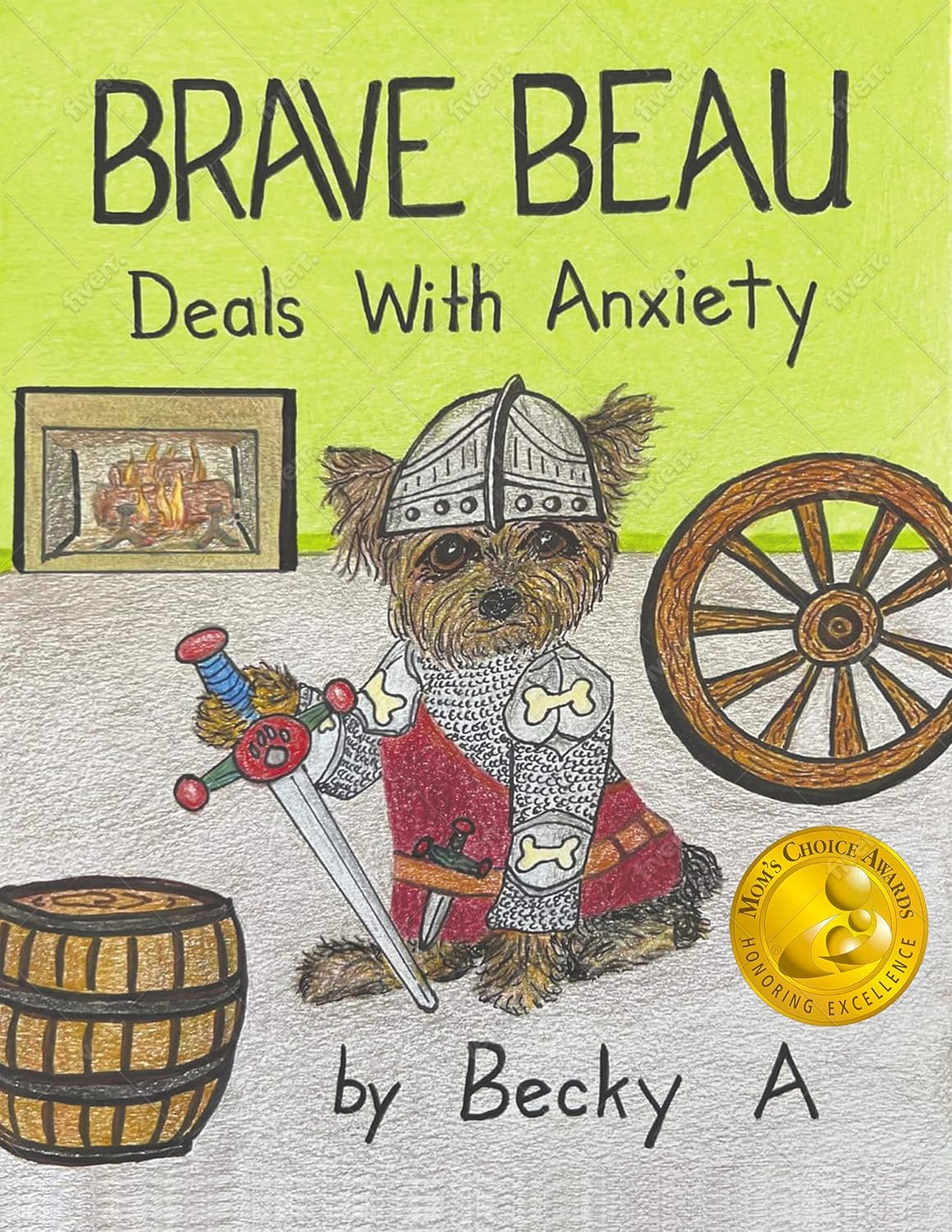 Beau, the Yorkie pup, faces feelings of anxiety. He is afraid of water, so baths are scary, He is afraid of learning to swim or riding in a boat until he faces these activities head on. He is afraid of noises in the dark. Through each challenge, Beau discovers something powerful: being brave doesn?t mean you are not scared, it means you do it anyway.